


Stop washing childhood away: why mud matters in toddler programs and in acknowledgement of International Mud Day, June 29
 Article
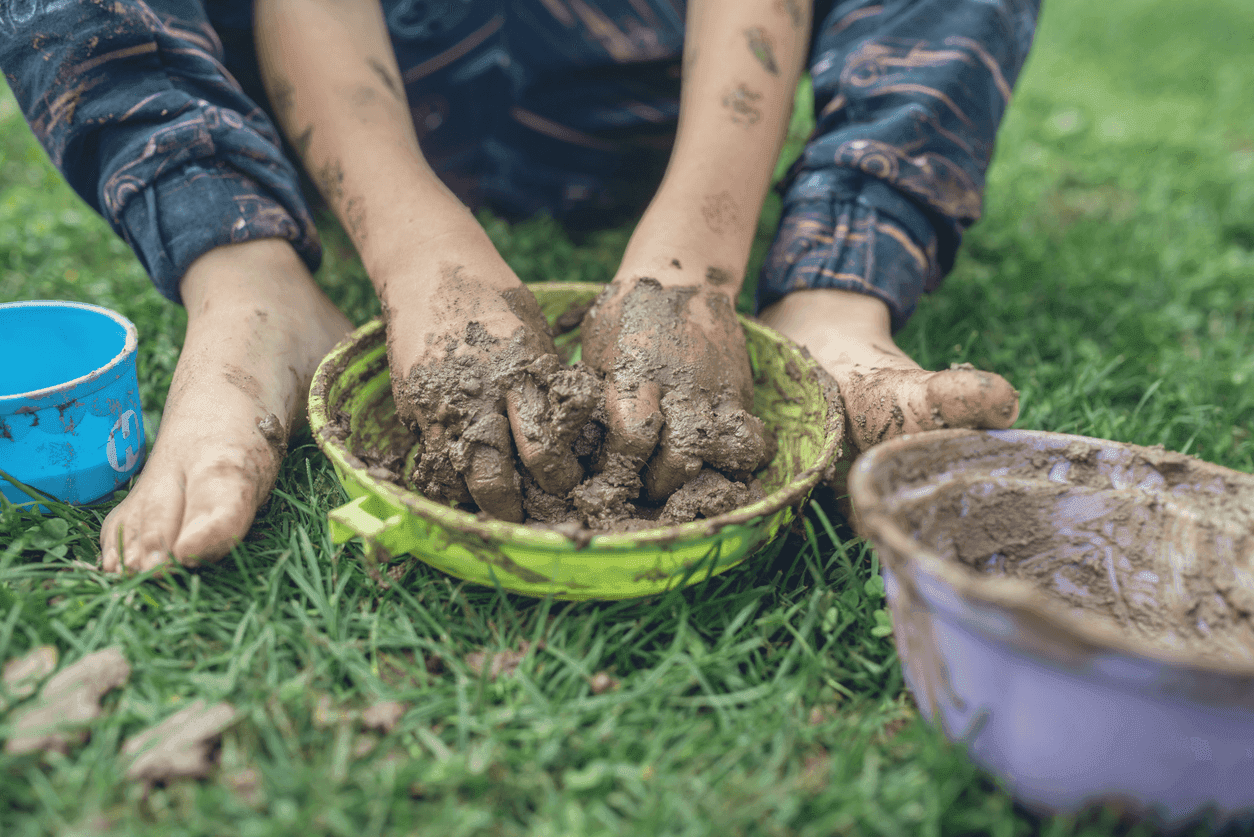
Anyone who has worked with toddlers will recognise the scene. It has rained overnight, and the outdoor environment is wet. Puddles have formed, the soil has softened, and toddlers are already making their way towards them. One child stirs mud with a stick; another presses their hands into wet soil and a third repeatedly transports water from the tap to a patch of muddy ground. For toddlers, muddy patches seem to exert an almost irresistible pull; for adults, however, the same scene can evoke a rather different set of considerations.
For educators, these moments may present a dilemma. The children are deeply engaged, yet the practical implications are immediately apparent. There will be muddy clothing, wet shoes, additional laundry, and perhaps questions from families at the end of the day. The impulse to redirect children towards cleaner, drier forms of play is understandable. Yet before we do, it is worth considering what draws toddlers to mud and what they might be finding there.
Despite growing recognition of the value of outdoor and nature-based play, mud often remains a source of discomfort within early childhood settings. It creates extra work, disrupts expectations about cleanliness, and resists easy control. Toddlers, however, seem unconcerned by these issues. They continue to seek out puddles, wet soil, and muddy patches with determination and curiosity. Perhaps the more useful question, then, is not whether mud has educational value, but what toddlers find in mud play that adults might overlook.
According to the World Forum Foundation (n.d.), International Mud Day is celebrated annually on 29 June and emerged from a conversation between educators from Australia and Nepal at the World Forum for Early Childhood Care and Education in 2009. The conversation highlighted two quite different challenges: in Australia, children were increasingly discouraged from getting dirty, while in Nepal many children lacked sufficient clothing to allow them to play in mud. What followed was an act of solidarity led by children in Perth and the establishment of what has become a global celebration of mud play.
More than fifteen years after its inception, International Mud Day continues to draw attention to the value of muddy play. However, there is a risk that Mud Day becomes a celebration rather than a challenge. We organise special events, document children's muddy experiences, and acknowledge the value of messy play, while spending much of the remaining year limiting children's encounters with the very material we have chosen to celebrate.
More Than a Mess
Toddlers experience the world primarily through their bodies. Long before they can explain their thinking, they investigate through touching, carrying, squeezing, pouring, poking, transporting, and repeating.
When a toddler presses both hands into wet soil, they encounter a material that is constantly changing. It feels different as it dries, responds differently under pressure, holds an imprint, and then loses it, sticks to the skin before falling away, and behaves differently depending on how much water is added. Through these experiences, toddlers notice patterns, test possibilities, and discover how materials respond to their actions. Unlike manufactured resources designed to produce predictable outcomes, materials such as mud, sand, water, sticks, leaves, and soil invite investigation, experimentation, and discovery. For toddlers, whose learning is deeply embodied and sensory in nature, these materials offer possibilities that cannot easily be replicated through commercial resources.
Mud is especially distinctive because it is never static. Unlike many manufactured resources, it responds to toddlers’ actions, changing in texture, consistency, and form as it is touched, mixed, transported, moulded, and manipulated. A muddy patch behaves differently after rain than it does on a hot afternoon; wet soil responds differently to pressure than dry soil; a puddle expands, contracts, and eventually disappears. Toddlers are not simply making a mess. They are investigating the properties of materials, noticing patterns and relationships, and exploring what happens when they act upon the world around them.
Mud, Microbes and Health
The significance of mud extends beyond learning alone. Research reported from Finnish early childhood settings suggests that increasing children's exposure to natural materials such as soil, plants, moss, and forest-floor environments resulted in measurable changes to children's skin and gut microbiomes, alongside indicators of improved immune regulation (Weston, 2025). Researchers argue that regular contact with environmental biodiversity may play an important role in supporting children's health, particularly during the early years when immune systems are still developing. From this perspective, muddy environments are not simply places for sensory play; they are opportunities for children to encounter the diverse microbial communities that form part of healthy ecosystems and may support children's health and wellbeing.
Mud, Place and Relationships
For early childhood educators, however, the significance of mud extends beyond questions of development and health. Relational approaches to early childhood education remind us that learning emerges through participation in relationships with people, places, materials, and communities. For toddlers, these relationships are often encountered through touch, movement, and sensory experiences. Children come to know their environments not through explanation but through repeated everyday encounters.
The muddy patch beneath the tree after rain. The puddle that forms beside the drain. The section of garden that becomes soft after watering. Over time, these places become familiar features of children’s everyday lives. Toddlers return to the, noticing their changes, exploring their possibilities, and discovering how their own actions shape what happens next.
This perspective invites us to reconsider the tendency to view mud as an occasional enrichment activity requiring special planning or equipment. For toddlers, mud does not need to be transformed into an activity before it becomes educational. It already is.
What This Looks Like in Practice
Toddler programs operate within practical constraints. Staffing considerations, family expectations, and the everyday unpredictability of life with children under three all shape what is possible in practice. Yet supporting mud play does not necessarily require a complete redesign of the outdoor environment. More often, it begins with a shift in thinking.
Rather than asking how mud can be controlled, educators might ask how mud can be accommodated. This shift recognises mud not as a problem to be eliminated, but as a natural and expected feature of children’s engagement with the outdoors. Practical measures such as access to water, spare clothing, designated muddy areas, and clear communication with families can help create environments where getting dirty is understood as an important part of the program rather than a problem to be avoided.
Equally important is resisting the urge to interrupt. Toddlers often engage with mud slowly and repeatedly. They come back to the same puddle, move water from one place to another, poke at wet soil with a stick, and observe what happens. What may appear to adults as inactivity or repetition frequently represents sustained investigation. A child who spends ten minutes moving mud from one puddle to another is not wasting time; they are exploring possibilities, testing ideas, and developing understandings through direct engagement with materials.
The role of the educator is not necessarily to direct the experience but to create the conditions that allow it to unfold.
The Other 364 Days
Perhaps the most important question raised by International Mud Day is not how we celebrate mud once a year, but how we respond to it during the other 364 days.
The evidence supporting outdoor, nature-based, and muddy play continues to grow. Yet the barriers to these experiences are rarely found in children themselves. More often they emerge through adult concerns about mess, cleanliness, risk, liability, and the practical realities of everyday life. These concerns are understandable. The challenge lies in determining whether they should always outweigh the opportunities that muddy play creates.
Toddlers engage with the world through movement, touch, repetition, and exploration. They learn by touching, carrying, pouring, mixing and repeating. Mud offers one of the richest opportunities for these forms of exploration because it invites children into relationship with a material that is constantly changing and responding.
Perhaps this is the question that International Mud Day continues to pose. Not whether we can create opportunities for mud play on a designated day each year, but whether we are prepared to recognise mud as an ordinary and valuable part of everyday toddler experiences. When we do, mud becomes more than a messy inconvenience or a special event. It becomes part of the lived experience of childhood.
For toddlers, mud is not simply something to play with. It is one of the many ways they come to know themselves, their environments, and the world around them. The question, then, is not whether mud belongs in toddler programs, but whether we are willing to make room for it.
Author
Karen Hope Consulting Disruptive Pedagogy
References
Weston, P. (2025, October 29). How a radical experiment to bring a forest into a preschool transformed children's health. The Guardian. https://www.theguardian.com/environment/2025/oct/29/soil-sandpit-children-dirty-biodiversity-finnish-nurseries-research-microbes-bacteria-aoe
World Forum Foundation. (n.d.). International Mud Day. https://worldforumfoundation.org/working-groups/nature-action-collaborative-for-children/international-mud-day/


Don’t miss a thing


Related Articles