






Is your training system keeping up with your growth?
 Marketplace
For many expanding ECEC providers, training consistency and compliance visibility are quietly falling behind, not through neglect, but because the systems built for smaller organisations were never designed to scale.
Across the early childhood education and care sector, provider growth has accelerated. More services are operating across multiple sites, expanding into new regions, and onboarding larger workforces than at any point in recent years.
For many, that growth has exposed a gap that rarely features strategic planning: the point at which an informal training system, functional and fit-for-purpose at a smaller scale, becomes inadequate for the organisation it now needs to serve.
The challenge is not limited to a specific provider type or size. It emerges when growth reaches a point where training can no longer be coordinated
Two distinct problems, often conflated
When growing providers identify a training gap, the response is frequently framed around compliance: ensuring mandatory requirements are met, documentation is current, and regulatory obligations are fulfilled ahead of assessment and rating visits.
Compliance, however, is only part of the picture.
The second challenge, and in many cases the more difficult one is consistency. In a multi-site environment, consistency means every educator receives the same induction regardless of which centre they join. It means policies translate into consistent daily practice across locations, rather than variations shaped by local culture or long-serving staff. It means a new service manager in a different state is working from the same baseline as one who has been with the organisation for years.
Compliance and consistency require different responses. Conflating them or addressing one while the other quietly deteriorates is one of the more common failure points in ECEC training as organisations scale.
Where growing providers typically lose ground
Research and practitioner experience point to three areas where training systems tend to break down as provider networks expand.
Completion visibility
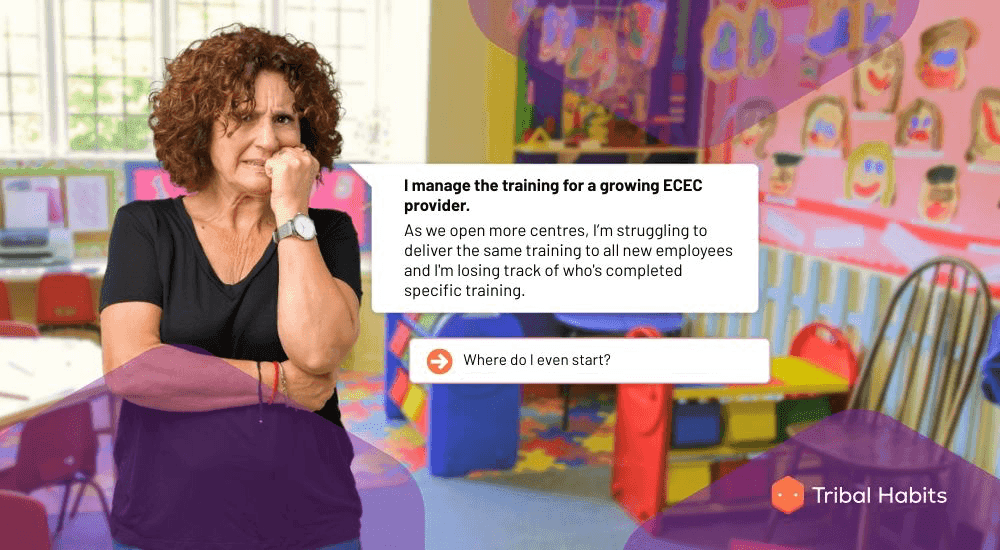
In smaller services, training oversight is often informal and effective. The service manager or Room/Team leader knows who has completed what. As headcount grows across multiple sites, that visibility disappears. Completion tracking becomes manual, inconsistent, or dependent on self-reporting. Gaps in mandatory training may only surface during an external review.
Induction consistency
Every new staff member should start with the same foundation, the same expectations, the same procedures, and the same understanding of how the organisation operates. In a growing provider, that can't depend on a senior manager or service manager delivering it personally every time. When induction is person-dependent, it becomes inconsistent by default. What a new educator learns in their first week varies by site, by who's available, and by how much time that person has.
Knowledge concentration
In many growing services, training coordination remains concentrated in one or two people. The systems, the content, and the institutional knowledge of what training exists and who needs it sit with individuals rather than in transferable processes. When those people are unavailable, or when they leave, continuity is at risk.
None of these failures are dramatic in isolation. They accumulate over time, often becoming visible only when a compliance gap is identified; a staff complaint is raised, or an experienced training coordinator departs.
These challenges are particularly relevant in the context of the National Quality Framework, where Quality Area 7 emphasises effective governance, leadership and continuous improvement across services.
A practical starting point
Providers do not need to undertake a lengthy system review to assess where their training stands. Three questions offer a reliable starting diagnostic.
Can organisations confirm, without manual investigation, which staff across all sites are currently overdue for a compliance renewal?
If the answer requires phone calls, spreadsheet checks, or email follow-up, completion tracking is not keeping pace with regulatory requirements.
If a new educator started at each centre today, would they receive an identical induction?
Not broadly similar, identical in content, sequence, and standard. Where the answer depends on who is rostered or which service manager is available, induction is a function of people rather than process.
If a training coordinator left tomorrow, how long would it take for another person to pick up their responsibilities without loss of continuity? Where the answer is measured in weeks rather than days, training knowledge is not yet held at an organisational level.

Building systems that scale
A key part of building a training system that grows with your organisation is implementing a Learning Management System, commonly known as an LMS. An LMS is a platform that centralises all of your training in one place, making it accessible to staff at any location, at any time. It allows you to create and deliver consistent training, track completions, communicate with learners and manage compliance across every site without the chasing, the spreadsheets, or the admin.
Some platforms also include ready-to-use content libraries covering common compliance and L&D topics, while others offer more sophisticated built-in course creation tools that allow you to build training that reflects how your organisation operates, without needing external developers or specialist software.
The providers navigating this transition most effectively share a common approach: they centralise before they optimise. Rather than investing immediately in sophisticated delivery tools or extensive content libraries, they focus first on bringing training into a single accessible place, one that any staff member can reach regardless of location, that records completion automatically, and that holds the same content for every site.
That shift does not require a large budget or a dedicated learning and development function. It requires clarity on where the current system is breaking and a structured approach to addressing it.
To help providers take stock of where their training system stands, Tribal Habits has developed a Training System Health Check, a guide to using AI to identify gaps in your training system before they become problems. It walks through six key areas: compliance visibility, consistency across centres, scalability, knowledge risk, capacity, and finding the right solution, using structured prompts you can copy directly into Claude, ChatGPT, or any AI assistant. Each prompt is designed to surface the specific gaps most likely to emerge as organisations grow. It requires no prior experience with AI tools.
Access the free Training System Health Check
This article was prepared in collaboration with Tribal Habits, an Australian-owned learning platform offering AI powered course authoring, an editable content library and LMS functionality for organisations operating across Australia and New Zealand.


Don’t miss a thing




Related Articles